
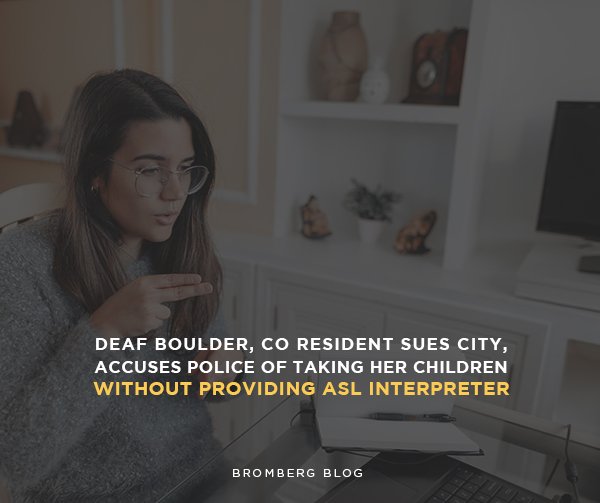
Joslynn Montoya sued the City of Boulder, Colorado in federal court for Americans with Disabilities Act (ADA) discrimination after city police did not provide her with an American Sign Language (ASL) interpreter despite her repeated requests for one. Miscommunications between Ms. Montoya and police officers ensued, resulting in the police taking her two children, ages two and seven months, from her custody on the night of the encounter.
Under Title II of the ADA, which applies to all local and state governments:
“When choosing a [communication] aid or service, title II entities are required to give primary consideration to the choice of aid or service requested by the person who has a communication disability. The state or local government must honor the person’s choice, unless it can demonstrate that another equally effective means of communication is available, or that the use of the means chosen would result in a fundamental alteration or in an undue burden (see limitations below). If the choice expressed by the person with a disability would result in an undue burden or a fundamental alteration, the public entity still has an obligation to provide an alternative aid or service that provides effective communication if one is available.”
U.S. Department of Justice Effective Communication Guidance, 2020
At the time, Ms. Montoya and her children lived in a domestic violence shelter. A local disability rights advocacy organization, Deaf Overcoming Violence through Empowerment (DOVE) worked with Ms. Montoya to assist her and advocate for legally required ASL interpreter effective communication.
One day, the shelter asked her and her children to leave the shelter by 5 p.m. Communication between Ms. Montoya and the shelter were ineffective. She believed she had until 7 pm to leave. The shelter called Boulder City Police, who arrived at the shelter around 3:30 p.m. That was when the ineffective communications took a tragic turn, resulting in the removal of Ms. Montoya’s children from her custody.
According to the Boulder Daily Camera:
“At about 3 p.m. that day, an employee at the shelter attempted to speak with Montoya, who was unable to understand her. Montoya then tried to communicate with the employee via Video Relay Service, which allows people with hearing disabilities to communicate with a voice caller via a sign language interpreter. According to the Federal Register, VRS is not considered a substitute for in-person interpreting services.
From her conversations with the employee, the lawsuit stated, Montoya understood that she and her children needed to leave the shelter by 7 p.m. and tried to find other accommodations for the night for her and her children.
Around 3:30 p.m., shelter staff summoned Boulder police to the shelter “for reasons unknown to Ms. Montoya,” the complaint read. At 5:30 p.m., while Montoya was on a call with her partner, Officer C. Davick arrived at the scene, followed by several others.
The officers were aware Montoya was deaf before they arrived, and according to reports from other officers, Davick had been called to assist because she knew sign language.”
In fact, Davick did not speak ASL. Instead, he communicated with Ms. Montoya by fingerspelling English words. Fingerspelling is not its own language, which ASL is. Instead, fingerspelling is used to spell out words, in English using the English language alphabet as in this case. The fingerspelled words invariably do not have a sign language equivalent. In the Montoya case, no police officers communicated in sign language and did not appear to know how to communicate in sign language with a deaf person whose primary method of communication is through sign language.
According to the lawsuit filed in U.S. District Court for the District of Colorado,
“Ms. Montoya cannot communicate effectively using fingerspelling, particularly for complex communication as occurred between her and the BPD Agents. Ms. Montoya was able to recognize that Officer Davick fingerspelled the words “trespass” and “arrest;” these terms confused Ms. Montoya because she was in her room packing and making arrangements to leave by 7:00 p.m. 55. Ms. Montoya requested that Officer Davick and the other BPD Agents provide her with a sign language interpreter for their communication. 56. Ms. Montoya saw Officer Davick shake her head, indicating what Ms. Montoya understood to be “no” in response to her request for a sign language interpreter…
As similarly reported in Sergeant Wise’s report, Ms. Montoya “began explaining to us that we could only communicate with her through and [sic] ADA certified interpreter.” Realizing that the BPD Agents were denying or ignoring her requests for a sign language interpreter, Ms. Montoya contacted her advocate with DOVE via video call hoping that her advocate could convince the BPD Agents that she needed a sign language interpreter…
According to Officer Davick: “After a difficult video interview it was decided that [Ms. Montoya’s DOVE advocate] and Sgt. Wise would communicate on text message about the plan. The reason for the text messages was because [the DOVE advocate] was also hard of hearing.”
Ms. Montoya recognized that the situation was continuing to deteriorate, prompting her to persist in requesting that the BPD Agents provide a sign language interpreter to avoid miscommunications in any way she could, including in ASL, through gestures and through vocalization. 74. Rather than provide Ms. Montoya with a sign language interpreter, the BPD Agents engaged in what Sergeant Wise deemed “a cyclical argument” with her and threatened her with arrest.
Ms. Montoya was unsure exactly what the BPD Agents were communicating, but she believed they were continuing to indicate that she needed to leave the shelter or she would be in trouble with the BPD Agents. 76. In an effort to get the BPD Agents to provide a sign language interpreter to avoid miscommunication, Ms. Montoya then contacted her case worker, Michelle, with the Boulder County Department of Housing and Human Services (“HHS”). 77. As Officer Davick reported, Ms. Montoya “also called child protective services where I spoke on a video with a woman named Tracie, I also diverted this person to Sgt. Wise for clarity and better communication.” 78. Ms. Montoya tried to use every available method to communicate her need for a sign language interpreter to the BPD Agents, but the BPD Agents refused to provide her with a sign language interpreter…
However, due to breakdowns in communication and her inability to communicate effectively in ASL, Officer Davick mistakenly believed that Ms. Montoya “was not able to provide a security deposit with a credit or debit card.” Sergeant Wise similarly misunderstood the situation, incorrectly believing that Ms. Montoya was unable to provide a credit or debit card for a [hotel] security deposit [for that night after leaving the shelter] and writing in his report: “After explaining to [Ms. Montoya] that she would be responsible for the deposit she made it clear that she did not have money to cover the deposit.”
Ms. Montoya in fact did have a debit card and funds she planned to use for the security deposit, and, in fact, used this debit card to pay the security deposit later that night at the hotel in Longmont reserved and paid for by DOVE. Because of a lack of effective communication, the BPD Agents incorrectly concluded that Ms. Montoya and her children would not be able to utilize the DOVE-reserved hotel that evening because Ms. Montoya did not have a debit card to use for a security deposit. The BPD Agents then unilaterally determined that they would remove S.L. and J.M. from Ms. Montoya’s custody for the night.”
In her lawsuit, Ms. Montoya claims violations of the ADA, Rehabilitation Act of 1973, and Colorado state civil rights law. The City of Boulder denies M. Montoya’s allegations. The case is still pending. Trial is scheduled for the summer of 2024 adjudicate Ms. Montoya’s case.
© Bruce L. Adelson 2023. All Rights Reserved The material herein is educational and informational only. No legal advice is intended or conveyed.
Bruce L. Adelson, Esq., is nationally recognized for his compliance expertise. Mr. Adelson is a former U.S Department of Justice Civil Rights Division Senior Trial Attorney. Mr. Adelson is a faculty member at the Georgetown University School of Medicine and University of Pittsburgh School of Law where he teaches organizational culture, implicit bias, cultural and civil rights awareness.
Mr. Adelson’s blogs are a Bromberg exclusive.