
Bromberg & Associates uses cookies or similar technologies as specified in the cookie policy. You can consent to the use of such technologies by closing this notice, by interacting with any link or button outside of this notice or by continuing to browse otherwise.
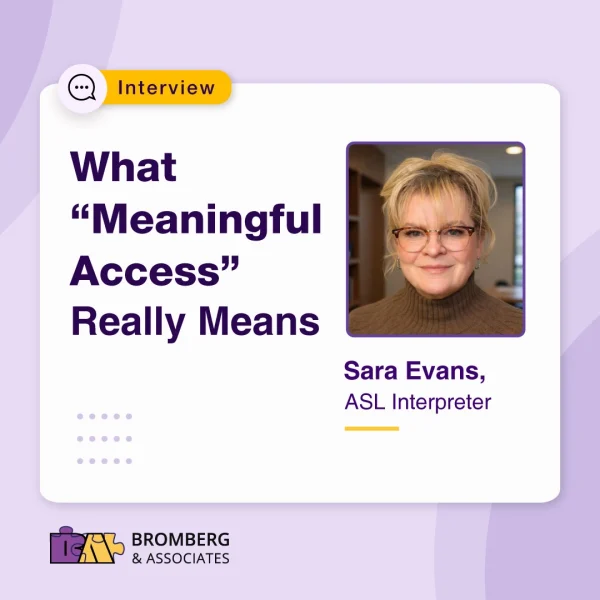
What “Meaningful Access” Really Means: A Conversation With Sara Evans – ASL interpreter
INTERVIEW
Can you describe your role as an ASL interpreter and what your work typically involves?
In general, I provide language access to Deaf and Hard of Hearing (DHH) consumers in a variety of settings. I have interpreted in almost every setting imaginable. It is much more involved than many might think. It requires a mastery of both English and ASL. The 2 languages are not the same. ASL has its own syntax, grammatical structure, and semantics. It is its own language. There isn’t a 1:1 equivalency. ASL is more conceptual. We interpret the English concept and not the literal words. An example I often use is the word FINE. It can mean everything is good, or it can mean you have some kind of penalty/punishment coming.
Specifically, here at Bromberg & Associates, I interpret primarily in the K-12 virtual setting. I began my career as a Teacher of the Deaf and was a bit apprehensive having come from the brick and mortar setting as well as residential schools for the Deaf. I will always be a big supporter of the benefits both culturally and educationally of residential schools. I expected students to be in a classroom with an iPad for interpreting. When I discovered everyone was virtual and realized the multitude of reasons for choosing K-12 virtual learning, I realized, for true access, DHH students should have this choice and access to effective communication should not be a barrier.
In your experience, what does “effective communication” really mean in ASL interpreting?
In a nutshell – equal access! It is more complex. As I mentioned earlier in navigating the two languages, there isn’t always a 1:1 interpretation. Add the layers of the humans involved, both Deaf and hearing, it becomes a very dynamic exchange. As an interpreter, I must know the language levels and preferences of the consumer and be able to match that in my interpretation. Is this a formal job interview or a medical appointment? What is the setting, who are the people involved? And how do I manage this in order to provide meaningful access? To ensure that the Deaf consumer is given all the information!
What is one (or more) common misconception people have about ASL or ASL interpreting?
Probably the most prominent is that it is “English on the hands” when in fact, as I have mentioned, it is its own unique language with the same linguistic features any other language has; grammar, syntax, morphemes, tense, everything!
Do people often assume that all Deaf or hard-of-hearing individuals communicate the same way? What should organizations understand about this?
I think most people believe DHH individuals can lipread, and for those that do lipread it is never accurate and exhausting for the individual. The diversity among the Deaf community is amazing! The many different ways to communicate are quite vast! Two things stand out for me about how an organization should approach this: Ask questions of both consumers – the hearing and the Deaf to know what the language needs are and know what the skills of your interpreters are. Another misconception is that sign language is Universal! This is completely false. Every country, dialect and cultural can have their own sign language and interpreters are not able to interpret in any sign language that exists.
When is Video Remote Interpreting appropriate, and when is in-person interpreting essential?
They both have a place and time! As I said earlier, the access in K-12 virtual school is very unique and we aren’t going to go to a student’s house and sit on the bed to interpret!
VRI does have a use in settings like routine appointments, Physical therapy appointments, some weekly work meetings that are not in depth. We also see it being used in rural settings where in-person is not viable. Where it should not be used is any setting where the Deaf consumer says they don’t want to use it, period. Serious medical situations – labor and delivery, for example, should not be virtual. When the message needs to be quick, precise, clear, it absolutely should be with an in-person interpreter.
What risks arise when organizations rely on unqualified interpreters or informal communication support?
It quite literally is life or death! Imagine interpreting a medication wrong and the patient is actually allergic? I tell my students who are working on their degrees in ASL Interpreting, we literally have the lives of Deaf consumers in our hands. Which is why there is rigorous certification and licensing for ASL interpreters nationally and state specific.
What communication barriers do Deaf individuals still encounter in professional, healthcare, or public settings?
Not having access! I am still amazed at professional settings where the Deaf consumer is expected to bring their own interpreter. Or they want to write notes back and forth which can be full of miscommunication. I have seen hospitals with highly educated professionals have zero understanding of their responsibilities. I think there is also a lack of respect for the Deaf consumer. They are viewed as less capable and disabled in a way that is not accurate. Deaf people can do anything hearing people can, except hear. That’s a quote from Dr.I King Jordan, the first Deaf president of Gallaudet University.
What can organizations do proactively to remove those barriers before an event or appointment even begins?
Speaking specifically about events, make sure everything is set up as it should be. The Deaf can see the interpreter, and the interpreter has full access to the speaker/presenter. It is very frustrating as an interpreter when I can’t hear the speaker.
For an appointment, organizations need to be proactive in making sure the staff using the VRI services are routinely trained on using the equipment and understanding how to work with a remote interpreter. Not just the technical parts but the practical ones. I don’t need to see the nurse, I need to see the patient on the screen, and vice versa.
Also making sure the interpreter has all the information needed. All the “W’s” – the who, what, when, where, etc. In educational settings, a lesson plan or an IEP is like gold!
How does preparation impact the success of interpreted interaction?
When we are interpreting, our brains are going a mile a minute! The more we know about the topic at hand, the less we must think about what it means, the context and concepts to interpret accurately. That is prep on our part. For the agencies, gathering that information and sharing it allows things to go more effectively. Matching the right interpreter with the right assignment is some great prep work too!
All of this is also in a perfect world. With interpreter shortages the way they are, it is quite the challenge!
If you could share one key message with organizations about ASL interpreting, what would it be?
We are professionals, we have worked hard to be in this field and are equal to the teacher, nurse, doctor, lawyer etc. Not that we ARE those roles, but we are professionals in the same way. If we are working in a medical setting for example, we are part of the care team and we should be treated as such.
Is there a moment in your career that clearly demonstrates why professional ASL interpreting matters?
I interpreted for parents who lost their oldest son who suffered a heart attack at the age of 28. When they arrived at the hospital behind the ambulance, there wasn’t an interpreter yet. Although they both knew what had happened, they saw it happen, they didn’t know why. They were completely lost until they had that language access. I also went with them to the funeral home to interpret and after that, she asked me if I would go with her to their primary care doctor so he could explain more – to allow her to ask questions the ER doctors didn’t answer. Without a qualified, professional interpreter, she could have called or emailed, but she wanted to sit down across from him and ask her questions. She was able to do that.
Bromberg & Associates
4,000+
Linguists
At Bromberg, we’ve made it our mission to provide professional translation
services that leave a lasting impression. Our human translators are up for the
challenge, whichever translation you need, standard document or certified.
We speak your language to convey your meaning to the world easily.
Sign up for our Email Newsletter to get the Latest Updates
By submitting this form, you are consenting to receive
marketing emails from: Bromberg & Associates. You can revoke
your consent to receive emails at any time by using the
SafeUnsubscribe® link, found at the bottom of every email.
Emails are serviced by Constant Contact.