

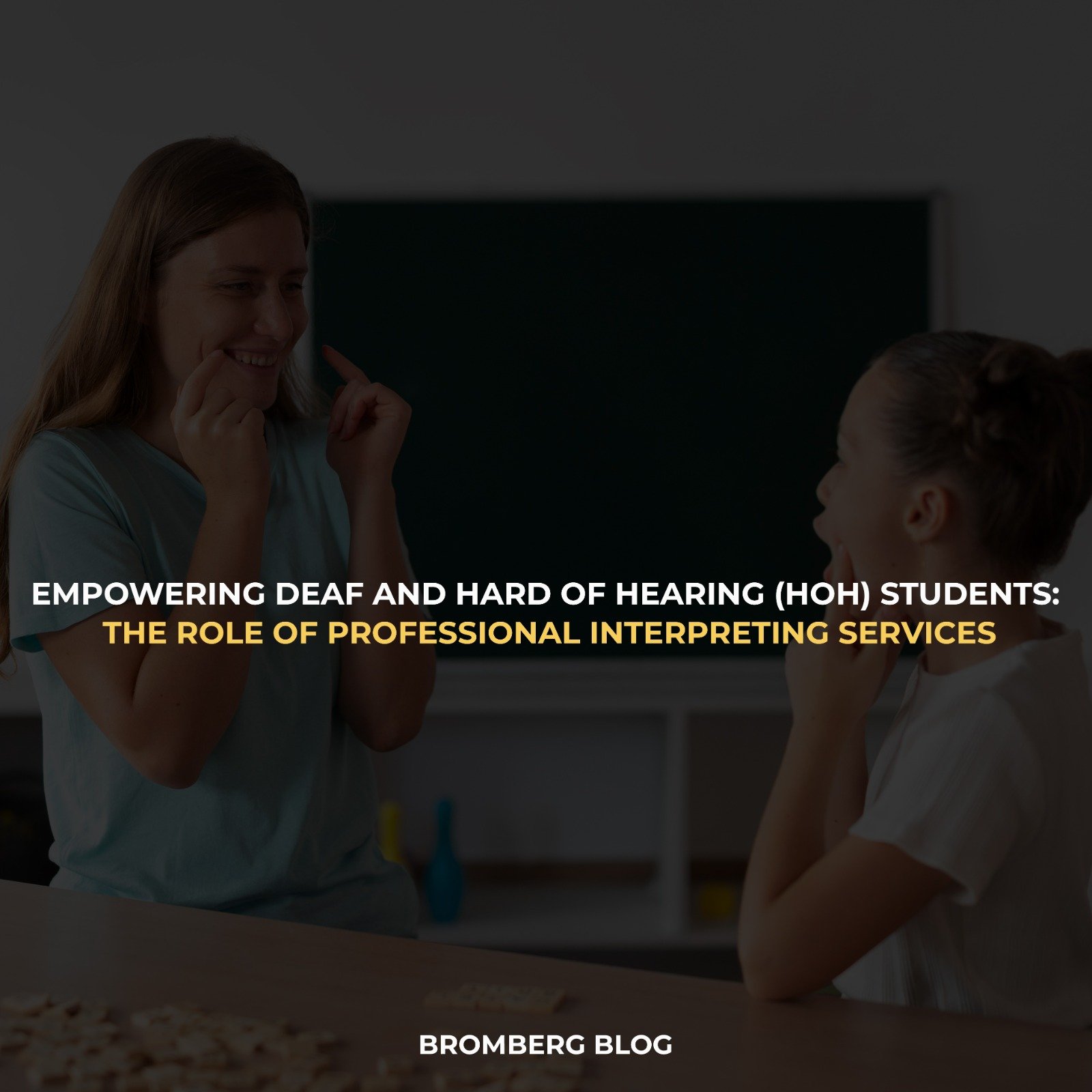
As the school year kicks off, ensuring that every student, regardless of their hearing ability, has access to quality education is more important than ever. For Deaf and hard-of-hearing (HOH) students, professional interpreting services are crucial for fostering an inclusive and supportive learning environment. Imagine a math or science class where complex equations or concepts are being explained verbally – without an interpreter, a Deaf or HOH student will miss out on crucial steps.
In the United States, there are an estimated 308,648 Deaf or HOH children between the ages of 5 and 17, according to the National Association of the Deaf. Professional interpreting services bridge communication gaps between educators, students, and parents. This ensures Deaf and HOH students can fully engage with their teachers and peers to excel in their studies. The most common types of effective communication services used in schools are:
- American Sign Language (ASL) Interpreting: ASL interpreters facilitate communication for Deaf and HOH students, interpreting classroom instruction, assemblies, and extracurricular activities.
- CART Services: Communication Access Real-time Translation (CART) services provide real-time captioning for Deaf and HOH students, allowing them to read spoken content on a screen.
Providing students with the necessary access to fully comprehend and participate in their classes significantly boosts their academic performance, ensuring they receive the same information as their peers and get the same chance to excel.
Overcoming Challenges
Implementing professional interpreting services can present challenges, including budget constraints and finding qualified interpreters. However, these challenges can be overcome with thoughtful planning and support from experienced language service companies like Bromberg & Associates.
Working with a reputable language service company ensures that schools have access to certified and experienced interpreters who are skilled in educational settings, while the long-term benefits of providing interpreting services far outweigh the costs. Schools can explore funding options through federal and state programs designed to support educational inclusivity initiatives.
Technology can enhance the delivery of interpreting services. Remote interpreting services provide flexible and cost-effective solutions for schools, ensuring that interpreting services are available when needed without the logistical challenges of on-site interpreters. For instance, using video remote interpreting (VRI) can connect students with interpreters through a video call, making it easier to have access during various school activities.
Using professional interpreting services ensures that a Deaf student can attend the after-school chess club or participate in a group project with their hearing classmates.
Building an Inclusive Environment
Inclusivity in schools promotes diversity and acceptance. When all students can participate fully, it fosters a sense of belonging and respect among the student body.
Inclusivity not only benefits students directly affected by hearing impairments, but also enriches the entire school community. When schools prioritize inclusivity, they promote a culture of empathy, understanding, and mutual respect. This cultural shift can lead to a more harmonious and productive learning environment for all students. An equitable educational experience prepares students for success in an increasingly diverse and interconnected world.
Needless to say, parents play a crucial role in a child’s education. By providing interpreting services, schools enable Deaf and HOH parents to actively participate in their child’s education, attend meetings, and understand important communications from the school. Parents who are engaged in their child’s education can make more informed decisions and provide better support at home.
Professional interpreting services can also serve as a valuable resource for educators. Training teachers and staff on how to effectively work with interpreters and understanding the needs of Deaf and HOH students can enhance teaching strategies and improve student outcomes.
Are you ready to make your school more inclusive? Contact us today to learn how our professional interpreting services can help you create a supportive and equitable learning environment for all students. Let’s make a difference in the lives of students and their families together.
Did you want to learn more about supporting Deaf and Hard-of-Hearing (HOH) students in virtual settings? Check out our previous blog on ASL solutions in virtual schools for additional insights.