

Election Day has come and gone. Now, analysis and evaluations of polling place activities will be completed to fill in the full picture of November 5.
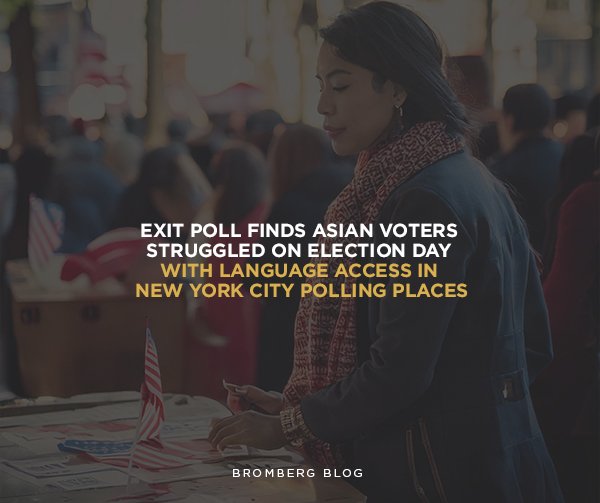
These election analyses will include barriers to LEP citizens attempting to exercise their right to vote. One such report has been released about language assistance at the polling places on Election Day.
As reported by Documented NY:
“language access was the most frequently reported issue, comprising a third of all incidents on Election Day. In New York City, 23% of Asian voters surveyed said they lacked access to interpreters. Additionally, 10% brought someone with them to assist in translation and 39% of those surveyed said they were only offered English ballots’
The report from the Asian American Legal Defense and Education Fund (AALDEF) revealed that language access was the most prominent issue for Asian American voters this election yea in several states across the country. According to AALDEF, the organization had over 600 volunteer poll watchers in 12 states throughout the Northeast, Southeast, Midwest, Southwest, and the West. AALDEF volunteers spoke with over 5,500 voters. The poll was conducted in English and in 10 Asian languages.
“Despite important protections for minority language speakers in the Voting Rights Act, we were troubled to hear from some voters that language assistance, even in places where they are mandated to provide interpreters, was unreliable, insufficient, or nonexistent,” said Bethany Li, executive director of AALDEF.
Documented NY spoke with on-site translators and voters at a polling place in Flushing, Queens, in New York City, where large groups of Asian immigrants reside. According to AALDEF: “Translator Hui Phing Tan saw only three other Chinese interpreters, despite over 120 requests from Chinese-speaking voters in the first six hours after the polls opened.
There aren’t enough interpreters — our schedules are tight, and our shifts are disrupted,” Tan told Documented. She also said that most Chinese voters she met were unaware of voter registration. New York isn’t the only city that struggled with language assistance. The exit poll showed Philadelphia as the other city with the most concerning incidents.”
The Director of the Census is authorized by the Voting Rights Act to make language assistance determinations based upon population and English language proficiency under the Act’s Section 203.
The Census Director determines Section 203 language assistance coverage using three population formulas (or “triggers”) applied to each jurisdiction: (1) more than five percent of the voting-age U.S. citizens are members of a single language minority and are limited-English proficient; (2) more than 10,000 voting-age U.S. citizens are members of a single language minority and are limited-English proficient; or (3) in a political subdivision containing any part of a Native American reservation, more than five percent of the American Indian or Alaska Native voting-age U.S. citizens residing on the reservation belong to a single language minority and are limited-English proficient. See: 52 U.S.C. § 10503(b)(2)(A).
As a result of the latest determinations in 2022, a total of 331 political subdivisions nationwide are now covered by the Voting Rights Act’s language requirements.
Under the VRA, language assistance, interpretation or translation, must be provided for:
- Voter registration materials ·
- Voting notices (including information about opportunities to register, registration deadlines, time/ places/locations of polling places, and absentee voting)
- Voting materials provided by mail ·
- All election forms
- Polling place activities and materials
- Instructions
- Publicity
- Ballots
- Other materials or information relating to the electoral process
The Voting Rights Act’s language requirements apply to four groups: Alaska Natives; American Indians; Asian-Americans; and Hispanics as well as the distinct languages and dialects within those groups. Thirty states must provide some level of language assistance for LEP voters.
For example:
- Language assistance for Seminole, which was required in past Section 203 determinations, was restored in Glades County, Florida;
- Language assistance in the Shoshone language, which was required in past Section 203 determinations, was restored in Nye County, Nevada;
- Spanish language assistance must be provided statewide in California, Florida, and Texas, and a total of 232 political subdivisions in 26 states, an increase from the 214 political subdivisions covered in 26 states under the 2016 determinations;
- Language assistance must be provided in Asian languages in 32 political subdivisions in 14 states, up from the 27 political subdivisions in 12 states covered in the 2016 determinations; and Wisconsin is now covered for Native American languages spanning 44 tribal areas in the state.
Source: 2022 Census Determinations Pursuant to Section 203, https://www.census.gov/programs-surveys/decennial-census/about/voting-rights/voting-rights-determination-file.2002.html#list-tab-1337476220
And
https://www.justice.gov/crt/language-minority-citizens
Currently, Section 203 requires Chinese and Korean language assistance in Queens County in New York City. Philadelphia County must provide Spanish language assistance under the VRA but has no Asian language requirements.
Language assistance in voting remains a significant barrier for LEP citizens. Despite Section 203, many locations in the 30 states required by federal law to provide interpretation and translation for voters, fall short, leaving voters uncertain how to navigate the voting process or unable to do so, a basic violation of the federally enshrined right to vote.
Documented NY provided several examples of LEP Chinese-speaking voters struggling with the mechanics of voter registration and completing their Election Day ballots:
“Asian American voters faced not only a lack of language access at the polls but also a shortage of in-language voter education materials beforehand. This lack of resources left many like Chen unprepared and ultimately led to difficulties voting. Tan said that of the nearly 30 Chinese voters she encountered, especially seniors, most were unaware they needed to register prior to voting. Asian Americans and other voters of colors have long had gaps in voter registration rates between them and white eligible voters.
After waiting to speak with an interpreter, 72-year-old Chen was told that she couldn’t cast her ballot because she hadn’t registered as a voter beforehand. “I didn’t know [about voter registration],” she said.
A poll worker at P.S. 020, who requested to remain anonymous, suggested that the Board of Elections increase the number of Chinese-language advertisements before elections to better educate Chinese voters about the voting process. “Some of them don’t even know about the Board of Elections,” the worker said.”
Poor or non-existent language assistance on Election Day, despite federal requirements, remain a consistent problem throughout the 30 states covered by Section 203. As more time passes from Election Day, we will doubtless receive more reports about LEP people experiencing Voting Rights Act violations that imperiled or impeded their precious right to vote.
© Bruce L. Adelson 2024. All Rights Reserved The material herein is educational and informational only. No legal advice is intended or conveyed.
Bruce L. Adelson, Esq., is nationally recognized for his compliance expertise. Mr. Adelson is a former U.S Department of Justice Civil Rights Division Senior Trial Attorney. Mr. Adelson is a faculty member at the Georgetown University School of Medicine and University of Pittsburgh School of Law where he teaches organizational culture, implicit bias, cultural and civil rights awareness.
Mr. Adelson’s blogs are a Bromberg & Associates exclusive.