


Word Count: 816
Reading Time: 5 minutes
Research by the National Foundation for American Policy indicates that immigrant workers have accounted for 88% of workforce growth in the United States since 2019. The data shows that over the past five years, only 479,000 U.S.-born workers were added to the U.S. labor force, compared to 3.6 million foreign-born workers.
Factors contributing to this gap include a shrinking working-age population among U.S.-born workers, compounded by pandemic-related retirements and mortality rates in an aging demographic, along with increased immigration.
As highlighted in this Forbes article, this trend underscores what many in the manufacturing industry experience daily. From automakers to suppliers, consumer goods plants to distribution centers, every player in the supply chain should be aware of the growing trends in employing foreign-born workers. This raises a critical question:
Is your company fully equipped to adapt to this reality?
Adapting to this workforce shift requires addressing linguistic and cultural diversity, as employees may have varying levels of English proficiency, including Limited English Proficiency (LEP). Effective communication strategies are critical for ensuring safety, regulatory compliance, and overall productivity.
Why should your company care about language access?
1. Safety
Safety instructions are non-negotiable in any factory setting. Misunderstanding even a single term can lead to serious hazards. According to the U.S. Bureau of Labor Statistics, safety-related accidents and fatal injuries have increased among foreign-born workers, especially Hispanic or Latino individuals as highlighted in the latest Census of Fatal Occupational Injuries (CFOI).
While machine translation tools are widely available, they can’t replace professional language access services that ensure precise, context-specific translations that are essential for clear and accurate communication.
2. Compliance
Regulatory adherence requires companies to meet safety training and compliance standards set by federal, state, and local governments, as well as certifying and regulatory bodies. Since 2010, the Occupational Safety and Health Administration (OSHA), part of the United States Department of Labor, has enforced its Training Standards Policy Statement, as stated here. The policy specifies that employers must provide training in a language and vocabulary employees understand.
Most recently, the OSHA highlighted once more the importance of language access for workplace safety and health in this article. In addition to its role as a government agency in charge of investigating measures taken by companies nationwide to ensure safety, the OSHA itself has implemented several initiatives to promote language access within the organization and through its various communication tools, such as newsletters and websites.
Localizing compliance-related materials into the language of your workforce is vital to ensuring alignment with industry regulations. A multilingual workforce must understand the technical terminology used in compliance and training materials, and accurate translation is essential to providing clarity and preventing misunderstandings.
3. Productivity
Recent surveys by the Bureau of Labor Statistics (BLS) and the American Community Survey (ACS) provided significant information about the English proficiency of foreign-born population, as highlighted in this article. The survey showed that in 2023, 46% of the individuals speak English less than “very well”. This reiterates the importance of multilingual communication strategies for a diverse workforce.
Multilingual communication enhances productivity by ensuring workers fully understand instructions, reducing errors, and streamlining processes.
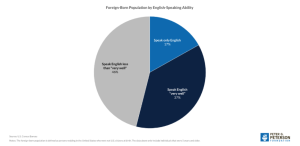
Source: https://www.pgpf.org/article/the-foreign-born-labor-force-of-the-united-states/
Precise communication—supported by professional translation and interpreting services—not only boosts efficiency but also fosters a positive, inclusive work environment that improves employee engagement and retention. For instance, Caterpillar Inc. This leading U.S. manufacturer of construction and mining equipment employs a diverse workforce in its manufacturing plants. To address language barriers, Caterpillar implemented a comprehensive language access system, including translated work instructions, multilingual signage, and on-site interpreters for training sessions. The company also provided digital tools like tablets with multilingual interfaces to help workers understand complex assembly processes.
These initiatives led to fewer production errors, reduced downtime during training, and an overall increase in assembly line efficiency, helping Caterpillar meet production targets on time while maintaining high-quality standards.
What language access services are right for your company?
Professional language access companies can tailor services to meet your organization’s unique needs. At Bromberg & Associates, we offer a comprehensive portfolio of services, including:
- Translation and Localization Services: High-quality document and website translation, with special attention to industry standards and cultural nuances.
- Interpreting Services: Expertise in simultaneous and consecutive interpreting, available via phone, video, or on-site.
- Accessibility Services: Solutions in American Sign Language (ASL), Braille, and WCAG compliance to foster inclusivity and meet accessibility requirements in the workspace.
- Audio-Visual Services: Localization of training videos, presentations, and other materials.
- Training and Consultation: Topics include federal compliance, SEO/ISEO solutions, Multicultural Awareness Program, and Multilingual Event Management.
The Takeaway
For the manufacturing industry, adopting language access services is no longer optional – it’s essential. As foreign-born workers continue to comprise a significant portion of the workforce, implementing multilingual tools and strategies is critical to fostering effective communication, maintaining operational efficiency, and ensuring safety and compliance.
Bromberg & Associates provides services designed to help your company adapt to the ever-evolving workplace. From professional translations to compliance consultations, we offer solutions tailored to your needs. Contact us today to learn more about how we can support your business.